Our Electrical Systems
Thanks to advances in battery chemistry, inverter technology and solar panel efficiency in recent times, it is now much easier to equip boats for comfortable off-grid living. However most boats still come out of the factory with fairly basic & limited electrical systems, so before we even closed on the purchase of Tranquila we knew it would need some major upgrades to make it ready for ocean crossings and long term family cruising. With insights gathered from the boating community and Leopard owners across social media we engaged the help of the Miles Solutions team at the port of La-Trinité-Sur-Mer in Western France to perform these upgrades.
Goal: maximise reliability, comfort, self-sufficiency
Reliability: going offshore or to remote places, we need the energy systems to work reliably with minimal maintenance. This requires quality equipment, installed properly and with built-in redundancy.
Comfort: being liveaboards with young kids, we want to be able to cook, make freshwater for drinking and washing, stay cool/warm and connected without worrying (too much) about power usage. This means a system that can provide enough power to run large appliances, even when used at the same time, and can store enough energy for a typical daily usage.
Self-sufficiency: we'd like to generate as much as possible of the energy we consume, so we can be less dependent on expensive & polluting fossil fuels or marina shore power. And also save time spent searching for a fuel dock or LPG refiller and maintaining & cleaning engines/generators.
As a 2020 model our Leopard 50 came from the factory fitted with typical basic power equipment:
5x 200Ah 12V AGM batteries
standalone 100A battery charger
110/220V 50A shore power transformer
9kW 220V diesel generator
125A alternator with Sterling battery charger on each Yanmar engines
3x 100W flexible solar panels on the forward part of the coachroof
standalone 3000W 220V AC inverter
gas cooking hob & oven with gas bottle locker in ventilated locker
Limitations & pain points we encountered with this factory set up:
AGM batteries can only be safely discharged to around 50% so really only stored about 6 usable kWh which isn't much. For instance the standard Starlink dish & router uses about 80W so keeping it online 24h a day uses about a third of that already
The flexible solar panels are small and often shaded by the sails so they generates enough to run the fridges but not much more
3000W inverter capacity is quickly reached (for instance if we run a kettle and microwave at the same time) meaning we have to think about & delay switching on appliances to avoid tripping the inverter
1200W battery charger greatly limits the speed at which we can replenish the batteries even though the generator or shore power could pull over 5kW
A gas hob is dangerous on a boat (especially with kids running around) plus it releases extra heat and moisture in the salon. On top of that it's tedious to clean and finding the correct refill can be difficult in certain locations.
Also:
The switch between shore and generator is manual, and require all AC loads to be disconnected first before going from one to the other
aircon and water heater can not run off battery at all, only when shore power is connected or the generator is running
The dinghy platform winch needs engine running to not overload batteries
charging batteries from engine alternator takes a long time
limited visibility into energy storage and power usage as there's only a battery voltage indicator with amps in/out, and no history no remote monitoring capability
What we wanted to change:
Install an induction cooktop and electric combined microwave/oven/aifryer to get rid of gas altogether, as it is quicker/cleaner/safer (and frees the gas bottle locker for storage as a bonus!)
Add enough battery & inverter capacity to be able to run any appliance whenever needed (including high power appliances like induction, AC, water heater for a short amount of time if needed) without shore power/generator
Maximize charging speed of batteries when shore power connected or engines/generator running to save time and avoid wasting fuel
Have most of our family daily energy needs covered by solar power on a good sunny day (so generator runs less often, only when the weather is cloudy or when we have extra guests on board consuming more)
How we achieved it:
We removed the batteries, charger and inverter and installed:
20kWh of lithium (LFP chemistry) batteries at 48V
Combined 10kW inverter/ 7kW charger
3kW bidirectional 12-48V DC-DC converters
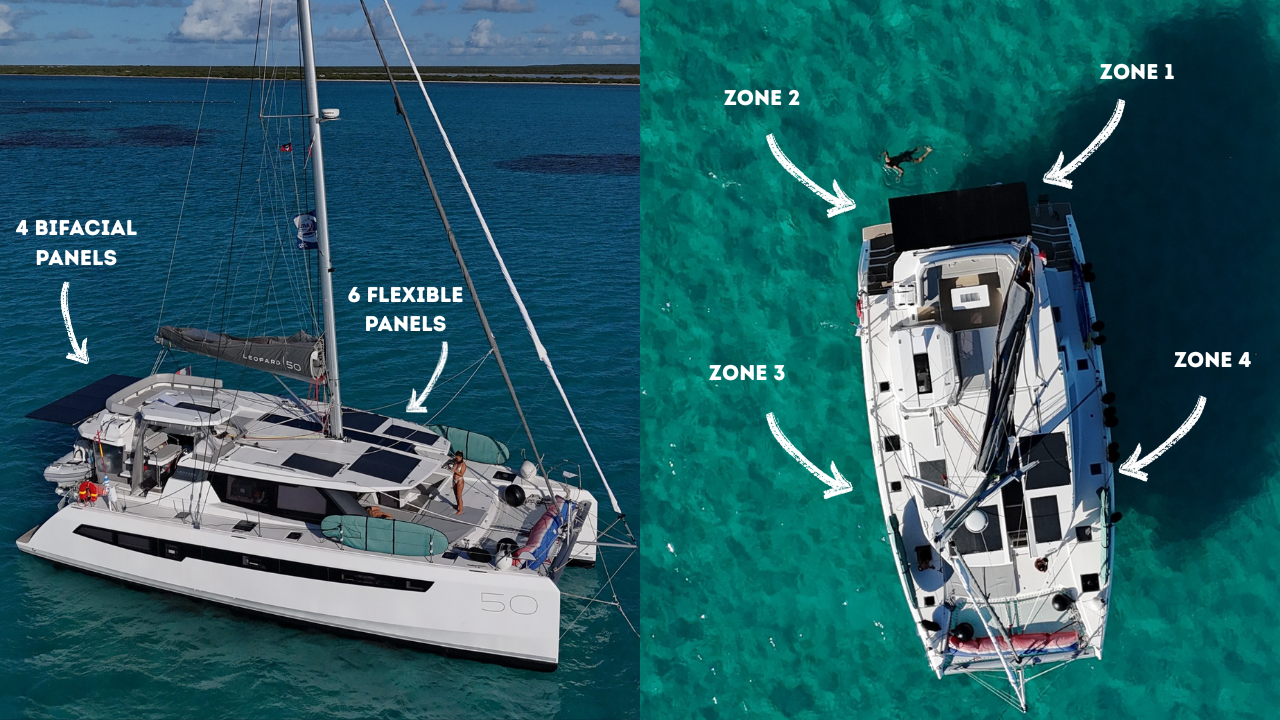
6x 250W flexible solar panels on the roof + 4x 450W rigid solar panels on a steel arch over the dinghy platform, for a total of 3.3kW peak
4 solar controllers regulating forward/aft/port/starboard solar panels to optimize for sun position & shade
All managed by Victron EkranoGX monitoring system which is connected to the Internet via Starlink wifi
Standard domestic induction cooktop (with max power limited to 5kW)
By moving to 48V the system becomes more efficient as the current to transport the high amount of power stored/inverted is divided by 4. This reduces heat losses in cables and inverters which allows the use of thinner cables, i.e. lowers weight and cost of much of the equipment.
To do this we installed 24V LFP batteries from Victron wired in group of 2 in series (as they don't offer 48V batteries) and 2x 5kW 48V Victron Quattro II inverter/charger (Victron does sell a 10kW model but we chose to install 2 smaller ones for redundancy).
The main difficulty with 48V is that all the existing DC equipment of the boat (alternator, winches, instruments, fridges, lighting, etc...) run at 12V, so a DC-DC converter is needed to power them from the 48V batteries. It needs to have a fast response and high power so when for instance an electric winch (1600W) is activated power is drawn from the 48V battery and instantly supplied into the 12V circuit.
Victron only offered the 350W Orion converter at the time so we would have needed quite a few of them in parallel to get enough power. Plus converters were also needed to move power the other way, from the 12V alternators to the 48V batteries. Also alternator regulators are highly recommended to avoid overheating them when charging lithium batteries which can take a high current for a long time, before abruptly cutting off when full.
Fortunately we came across Safiery, a small but very innovative Australian company which had recently launched their Scotty smart DC-DC converters. They are the missing piece in this 48-12V puzzle as they can convert power both ways instantly and up to a huge 3kW (more than enough to run our 1600W windlass straight off batteries). Plus they monitor the temperature of the 12V engine alternator in order to maximize battery charging speed without risk of damage.
The Scotty responds so fast that in theory no 12V battery is needed at all, although we did keep one as a buffer for redundancy (and we also installed a 2nd Scotty as we have a catamaran with 2 engines and 2 alternators).
What would we do differently/improve?
After more than a year living aboard and several thousand miles of offshore and remote sailing we are very satisfied with this system which has delivered on all objectives. Other than a small but puzzling charging issue due to the fusing of the 2 Quattro inverters in parallel which we resolved with Victron a few months in, everything has worked really well.
We have been cooking and running our watermaker and 24h Starlink mostly on solar power, and are able to run a water heater or AC for a couple hours off batteries alone. We ran the generator occasionally on cloudy days when friends & family visited, requiring more freshwater, or when sailing for several days at an angle where the sails shade the sun. And its full 7kW output can be pumped straight into the batteries which reduces running time.
One improvement we considered when installing the system but kept for later is to upgrade the 12V engine alternators to 48V models as well. This allows much higher power to be generated when the engines are running (typically 5+kW) so even when just motoring out of a marina or around an anchorage can be enough to replenish a significant amount of the batteries, making the most of every drop of fuel burnt. Several solutions are available (Integrel, Zeus, and now also Safiery's BMG) and we will definitely install that if/when the generator fails.
Also as the saying goes, "no one ever complained of having too much solar", so we would consider adding some more. We have seen aft arches with extra legs bolted on the sugar scoop supporting 6 full size panels, and there are still spots on the roof where smaller flexible panels could be added, though the wiring does become complex.